
+1 240-244-4364 | amy@impacthypnotherapy.life

What My Classroom Taught Me About Stopping Bullying
By Amy Ross, former teacher and Certified Hypnotherapist
Quick answer: The bullying prevention programs with the best results change the culture of the whole group, not just one child's behavior. Bullying shrinks when it loses its audience and kids feel safe telling an adult, and emotional resilience is what helps a child actually do it.
Bullying Prevention Is Worth Tackling, and Here Are Ideas to Start With
Last month was National Bullying Prevention Month. The blue shirts and the hashtags are put away, but the kids are still in the hallways, on the bus, and in the group chat. So this conversation isn't over.
I began my career as an elementary-school teacher in a Colorado district south of Columbine. I wanted every child to feel safe and welcome, but conversations about bullying needed care; the subject was especially sensitive in our community. Early that first year, I asked my students, “What is bullying? How would you know if it were happening to you? How would you know if it were happening to someone else?” Their answers opened a conversation we returned to throughout the year. I didn’t have a formal prevention guide, so I drew on what I had studied during student teaching and what I believed: students should be able to talk honestly about harm and help shape a classroom where bullying wasn’t tolerated.
The wider school environment didn’t always make that easy, and I often felt unsupported. Still, I kept trying to create a classroom where students could speak openly and take responsibility for how they treated one another.
After I left teaching, I volunteered with local organizations advocating for common-sense gun laws in Colorado. Bullying prevention remained important to me and often surfaced in my advocacy. I continued asking what effective prevention looks like, not only in schools, but in the ways parents and caregivers support children at home. I wanted to understand which approaches could help create safer school communities, consistently and over time.
What the Research Says About Bullying Prevention
When I started reading the research on bullying prevention, I recognized my own classroom in it. I'm sharing what I found here so you can look at it for yourself.
The programs with the best results around the world don't rely on a single assembly, a poster in the hallway, or punishing one "bad kid." They change the culture of the whole group. They get everyone talking, they make the rules shared, and they give every child a part to play.
Three programs stand out:
Olweus (Norway)
Regular class meetings, clear rules everyone agrees on, and every adult on the same page, from teachers to lunch staff to bus drivers.
KiVa (Finland)
Teaches the kids who watch bullying to stop rewarding it with laughter, attention, or silence, and to stand with the child being targeted.
NoTrap! (Italy)
Student volunteers lead the change, in class and online. Especially strong for teens and cyberbullying.
The results are encouraging. A large review of school programs worldwide found that good programs reduce bullying by about a fifth on average (Gaffney et al., 2021). In Norway, schools that used Olweus fully saw bullying drop by roughly half (Blueprints). KiVa was tested with more than 8,000 children in 78 Finnish schools, and kids reported less bullying and liked school more, even the ones who were never directly involved (Kärnä et al.). NoTrap! cut cyberbullying, and the change was still there six months later (Palladino et al.).
The research also shows where programs fall short: when schools do them halfway. A one-time lesson, rules nobody follows through on, or staff who were never trained. Change takes the whole community, and it takes time.
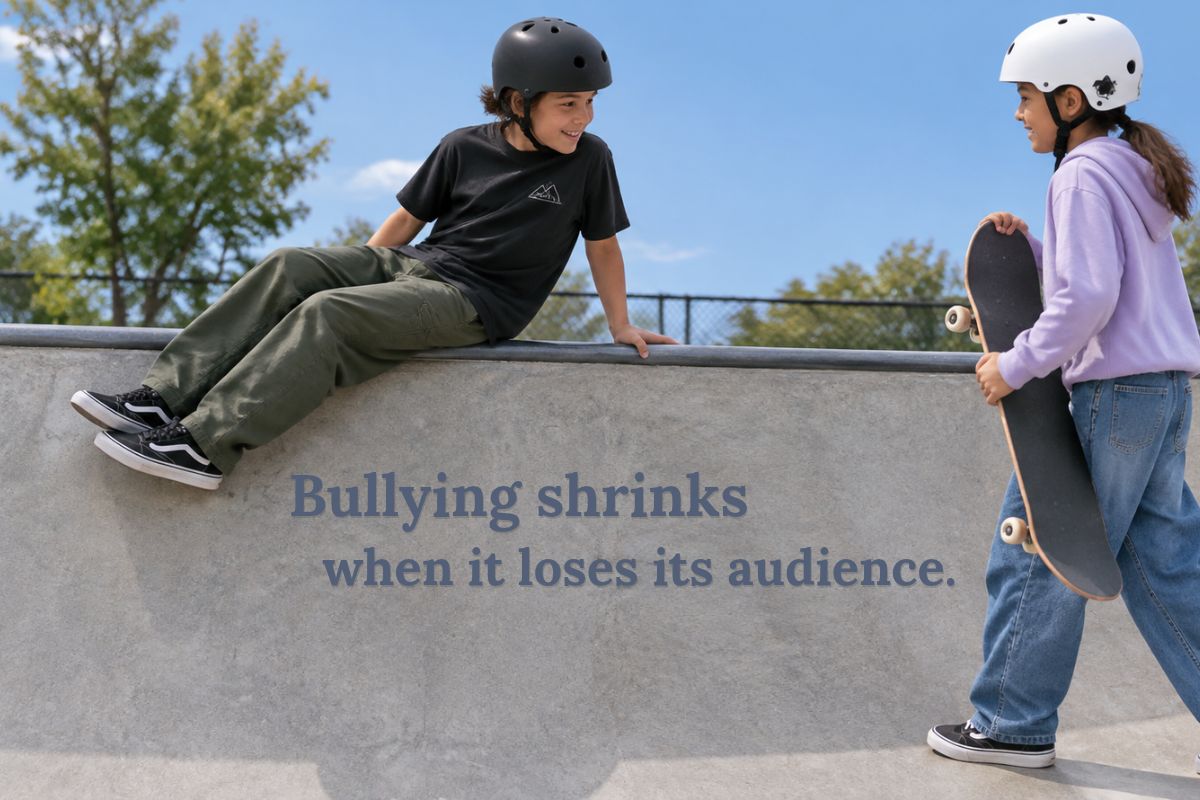
If I had to sum up decades of research in one line, it would be this: bullying shrinks when it loses its audience and kids feel safe telling an adult.
Why Emotional Resilience Is the Missing Piece
Good programs teach children what to do. Stand with the person. Walk away together. Tell an adult.
But knowing what to do and being able to do it are two different things. In the moment, a child's heart is pounding, their face is hot, and every eye in the lunchroom seems to be on them. That is where emotional resilience comes in. It is the ability to feel a big feeling, settle your body, and still choose what you do next.
Three kids need it most:
- The child who is targeted, so they can speak up, ask for help, and recover instead of carrying it for years.
- The child who is watching, so they can move from frozen to helpful. Most kids want to help. Many simply freeze.
- The child who bullies. This one surprises people. Children who bully are often carrying stress, fear, or hurt of their own, and they pass it on because they don't yet know another way to release it.
This reaches far beyond the schoolyard. We are living in a divided time, and it is easy to look for someone to blame. People with more emotional resilience have less need to push their pain onto someone else. They can feel what they feel, stay steady, and stay kind. That is something we can teach our kids, and something we can grow in ourselves.
When Bullying Leaves a Mark
Bullying doesn't always end when the bullying stops.
Many kids stay on guard long afterward. They replay what happened at night. They dread the bus, the locker room, or the group chat. New worries show up: stomachaches before school, trouble sleeping, pulling back from friends. Children who have lived through frightening events at school need the same thing: support that helps them feel safe again, not just a reminder to "move on."
This is where I help. As a Certified Hypnotherapist, I work with kids, teens, and families to:
- Ease the fear that stuck around, so school, friends, and new places feel possible again.
- Help the body settle, so a racing heart and tight stomach no longer run the day.
- Quiet the replay, so an old moment stops playing on repeat.
- Build steady confidence, so a child can speak up for themselves and others.
And it isn't only children. I have helped many adults release bullying they carried from their own school days, from classmates and sometimes from teachers. Decades later, they find they can walk into a room, speak in a meeting, or parent their own kids without that old weight.
That matters, because parents set the emotional tone at home. When you become calmer and more resilient, your children learn it by watching you. You can teach your kids a better way than you were taught.
Here is how my programs fit:
- Cultivate Emotional Resilience (one-on-one): for a child, teen, or parent who wants steadier emotions and stronger self-trust.
- Build to Last: Human Ecology (online group; launching in January. Contact me or stay tuned for experiential webinars until then to get more info and exact dates): for parents who want to lower their own stress and bring that calm home.
- Stress and Anxiety Relief: for the worry, dread, and tension that bullying often leaves behind, and for building self-confidence and emotional regulation.
- Heal from a Broken Heart: because losing a friendship hurts too. When a friend group turns on a child, that is real heartbreak.
- Trauma release (one-on-one): for a child, teen, or adult who is still carrying a frightening experience, such as a school shooting, a threat, or violence, and needs to feel safe in their body again. This is a focused one-on-one protocol I use to help people release the hold an experience has on them.
Hypnotherapy can help you work through these challenges on its own, and it also works well alongside the care that school counselors, therapists, and doctors provide. If a child is in danger, the first step is always adult action: the school, and when needed, the authorities.
What Parents Can Do at Home
1. Make "no bullying" a family rule, out loud. Say it plainly: in our family, we don't bully, and we don't let it slide. That includes brothers and sisters, cousins, and what happens online. Kids take their cues on what is acceptable from what we allow at home.
2. Ask the school what program they use, and how they use it. Ask: Which bullying prevention program do you use? Is it schoolwide? How do students report bullying, and what happens next? Who follows up with families? A poster or a one-day assembly is not a plan. You have every right to expect one, and other parents will often join you in asking.
3. Open the door to talk, and keep it open. Kids rarely answer "Are you being bullied?" honestly. Instead, ask about the places where bullying happens: "Who did you sit with today?" "What's the bus like?" "Is anyone being left out in your group chat?" Then listen without rushing to fix it. A child who feels heard comes back to talk again.
4. Teach one bystander move. Practice it at home like a fire drill: stand next to the person, say "Come on, let's go," walk away together, and tell an adult. Remind your child that telling isn't tattling. Tattling gets someone in trouble. Telling gets someone help.
5. Model calming down where your kids can see it. Say it out loud: "I'm really frustrated right now, so I'm going to take three slow breaths before I answer." Children learn regulation by watching it far more than by hearing about it.
6. Write it down and follow up. If your child is being bullied, note what happened, when, and who was there. Share it with the school in writing and ask for a follow-up date. Clear records help schools act.
7. Notice when it's lingering. If weeks later your child still dreads school, can't sleep, or seems more on edge than before, that is a sign they need support to recover, not just time. That is exactly the kind of help I offer. Keep reading below to see how I can help.
Quick Quiz: How Ready Is Your Family's Bullying Action Plan?
Seven quick questions, taken while the ideas are fresh. Your results show you where to start.
Take the quizYou Don't Have to Tackle Bullying Prevention Alone
Every child should be able to feel safe at school, and every parent should have support in helping them get there. You don't have to carry this alone, and you don't have to figure it all out at once.
If you'd like support, I'm here. As a former teacher and now a Certified Hypnotherapist, I help children, teens, and parents release the weight of a frightening experience, ease stress and anxiety, and build steady confidence. Your child already has what they need to feel strong. I help them find it, and I can help you find it too.
If bullying has left a mark on your child, or on you from your own school years, I'd love to hear your story.
Book your free introductory callResources
- StopBullying.gov: guides for parents and schools from the U.S. government
- PACER's National Bullying Prevention Center: started National Bullying Prevention Month (October)
- KiVa program
- Olweus Bullying Prevention Program
- PBIS: Bullying Prevention
- Review of school anti-bullying programs (Gaffney et al., 2021)