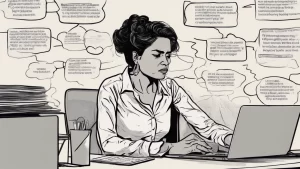
Beyond the Beeps: 3 Surprising Reasons Your Meditation App Isn’t Curing Your Burnout
Does this sound familiar?
Another notification buzzes on your phone. “Time for your daily 10-minute mindfulness session.” You take a deep breath, close your eyes, and try to follow the soothing voice. But instead of finding a quiet mental oasis, your mind is a traffic jam of deadlines, to-do lists, and that one awkward thing you said in a meeting three days ago.
Ten minutes later, you feel… the same. Maybe even a little more frustrated. You’re trying so hard to fix this exhaustion, this deep-seated feeling of being over it all. Yet, despite your collection of meditation apps, the meditation apps burnout cycle continues.
If you’re a high-achiever, a creator, a leader, you’re used to solving problems. So, when the go-to solution for stress isn’t working, it can feel like a personal failure.
Let’s be gentle here for a moment. What if the problem isn’t you? What if the tool itself, while well-intentioned, simply isn’t designed for the depth of the issue? This isn’t about ditching mindfulness. It’s about understanding why a surface-level approach may not be enough and discovering what your mind and body truly need to heal.
Reason 1: Are Your Meditation Apps Just a Symptom-Solver for Burnout?
Think of your burnout as a leaky pipe in your home.
Right now, your meditation app is the bucket you place under the drip. It’s helpful! It catches the water and prevents a mess on the floor for a little while. That 10-minute session can provide a moment of temporary relief—a brief pause in the relentless drip, drip, drip of stress.
But it doesn’t fix the pipe.
The Surface vs. The Subconscious
Burnout isn’t just “being really tired.” It’s a state of chronic stress that has fundamentally altered your nervous system’s baseline. Your internal “fire alarm” (the sympathetic nervous system) is stuck in the ‘on’ position.
Most meditation apps work on the conscious level. They engage the part of your mind that thinks, analyzes, and worries. They ask you to consciously notice your breath or consciously release tension. This is a valuable skill, but it’s like trying to reason with a fire alarm while the building is (or feels like it is) on fire.
The root cause of the alarm—the reason your system is so hyper-vigilant—lives deeper, in the subconscious. This is the part of your mind that runs your automatic responses:
- That jolt of adrenaline when you see your boss’s name in an email.
- The immediate clenching in your jaw when you think about your workload.
- The ingrained belief that your worth is tied to your productivity.
These aren’t conscious choices. They are deeply learned patterns. And a 10-minute conscious exercise rarely has the power to rewrite them.
When Calm Becomes Another Chore
For many driven people, the app’s notification becomes just another item on an endless to-do list.
- Finish project proposal
- Respond to 50 emails
- Achieve inner peace
- Pick up groceries
When wellness feels like a task to be completed and graded, it only adds to the pressure. Have you ever felt guilty for missing a day? Or judged yourself for not being able to clear your mind? You’re not alone. This is a sign that the approach is addressing the symptom, not the underlying pressure-cooker environment your nervous system is living in.
Reason 2: Why Your Willpower Isn’t Enough for Burnout Recovery
If willpower alone could cure burnout, you would have been healed long ago. You’ve built a career, a business, or a life on your ability to push through, to execute, to make things happen.
So why can’t you just “will” yourself to be calm and happy?
The answer lies in understanding the two key players in your mind: the conscious mind (the CEO) and the subconscious mind (the entire company workforce).
Meet Your Autopilot: The Subconscious Mind
Your conscious mind sets the goals. “I want to feel less stressed.” “I want more energy.” It’s the visionary, the strategist.
Your subconscious mind runs the show. It handles about 95% of your daily operations—your heart rate, your breathing, your habits, your emotional reactions, and your core beliefs. It’s the powerful, efficient, and deeply ingrained autopilot that learned how to keep you safe and successful based on past experiences.
For many high-achievers, that autopilot learned a specific script:
- Stress = motivation.
- Rest = laziness.
- Vulnerability = danger.
- Perfection = safety.
This is why, even when you’re consciously trying to relax, your subconscious might be screaming, “Get back to work! You’re falling behind! This is a waste of time!”
The Limits of Listening
When you use a standard meditation app, you are sending a suggestion to the CEO (your conscious mind). But the workforce (your subconscious) is still running the old, stress-inducing programs. It’s a recipe for internal conflict and frustration. You’re fighting a battle against your own highly efficient operating system.
True burnout recovery requires more than just listening; it requires a new form of communication. It requires getting the CEO and the workforce into the same room, speaking the same language, and agreeing on a new, healthier business plan. This is precisely what a focused learning state like hypnotherapy is designed to do. It opens a direct, collaborative line of communication with your subconscious so you can update those outdated programs with new, supportive ones.
A technique we explore deeply in our Stress S.O.S. program is helping you become the compassionate leader of your own inner world, not just a frustrated manager.
Reason 3: From Passive Listening to Active Healing: The Missing Piece in Your Mindfulness for Burnout Strategy
Imagine you want to learn to play the guitar.
You could download an app and listen to hours of beautiful guitar music. You might learn to appreciate the nuances of the chords and the rhythm. But would you ever learn to play?
Probably not. To learn, you have to pick up the guitar. You have to place your fingers on the frets, strum the strings, and actively create the music yourself. Your brain has to form new connections through direct experience.
Standard meditation apps often position you as a passive audience member. You are listening to someone else’s instructions. Hypnotherapy for stress, on the other hand, hands you the guitar.
What is a Focused Learning State? (Hint: It’s Not About Clucking Like a Chicken)
Let’s clear the air about hypnosis. It’s not about losing control. In fact, it’s the opposite. Hypnotherapy guides you into a state of highly focused attention—much like being engrossed in a great book, a movie, or a creative project.
This is a natural state where the noise of the conscious mind quiets down, allowing you to access the incredible learning capacity of your subconscious. It is a state of deep physical relaxation but heightened mental awareness. This focused state is the optimal environment for neuroplasticity—the brain’s amazing ability to rewire itself.
Rewriting the Stress Script
In this focused learning state, you move from being a passive listener to an active creator of your well-being. Instead of just hearing the word “calm,” you can guide your own mind to generate that feeling from within, anchoring it into your nervous system.
You can actively:
- Visualize a different response to a stressful trigger.
- Access forgotten feelings of joy, playfulness, and ease.
- Communicate a new sense of safety and security to your nervous system.
- Dissolve old, unhelpful beliefs and replace them with empowering ones.
This is the difference between being told there’s a peaceful place and actually building that peaceful place inside yourself, a sanctuary you can return to anytime, with or without an app.
Frequently Asked Questions
Weaving in some answers to the questions you might be pondering right now.
Q1: Can hypnotherapy really help with work stress?
Absolutely. Work stress and burnout are often driven by subconscious patterns around perfectionism, imposter syndrome, and the fear of failure. Hypnotherapy is uniquely effective because it works at this subconscious level to update these patterns, helping you build genuine resilience, set better boundaries, and disconnect your self-worth from your professional output.
Q2: Is hypnotherapy the same as meditation?
They are related but distinct. Think of meditation as observing the weather of your mind. Hypnotherapy is like learning to change the weather patterns. While meditation builds awareness, hypnotherapy is a more goal-oriented process that uses that awareness to actively create specific, lasting change in your thoughts, feelings, and behaviors.
Q3: How long does it take to see results for burnout?
Because we are working directly with your mind’s learning state, many clients feel a significant sense of relief, calm, and clarity after the very first session. Lasting change from deep burnout is a process, but it’s often much faster than people expect. The goal isn’t a quick fix, but to give you the tools for sustainable well-being, a journey that begins with the very first step to Heal Heartache and professional exhaustion.
Q4: What if I can’t be hypnotized?
This is a common myth. Anyone who can become absorbed in a good movie or a daydream can enter this focused state. It’s a natural human ability. The only requirement is a willingness to be curious and allow the process to unfold. It’s a collaborative journey, and you are in control the entire time.
Your Path From Surviving to Thriving
Don’t get me wrong, meditation apps are not the enemy. They are a wonderful introduction to mindfulness for millions.
But for the deep, soul-level exhaustion of burnout, they are often just the first step on a much deeper journey. True, lasting recovery comes from:
- Going beyond the symptoms to address the root subconscious patterns.
- Aligning your conscious goals with your subconscious programming.
- Moving from passive listening to actively rewiring your relationship with stress.
You don’t need another tool that makes wellness feel like a chore. You deserve a process that feels like coming home to yourself—a process that unlocks the calm, confidence, and joy that are already within you, just waiting to be rediscovered.
Feeling ready to move from surviving to thriving? Your journey toward calm and clarity starts with a single step. Book a complimentary discovery call today to explore how we can tailor a path for you.