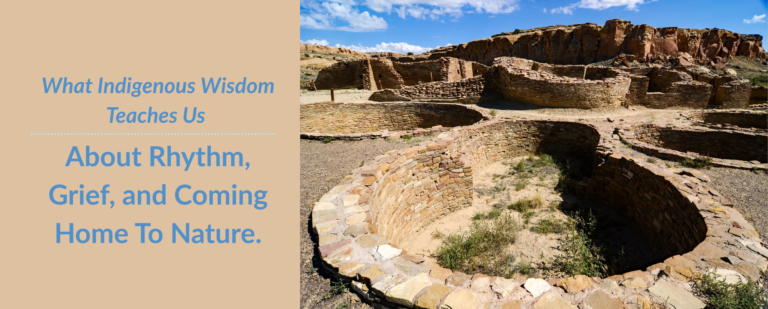
Today is Indigenous Peoples’ Day. It’s a day to honor the first peoples of the lands we live on, their resilience, and the wisdom they have carried through generations, often at great cost.
I’m not here to speak for Indigenous people. I’m here as someone who has been deeply moved by what many Indigenous traditions have kept alive while much of the modern world forgot it: we are part of nature, not separate from it. And when we live as if we’re separate, something in us gets sick.
I’m Amy Ross, an NGH certified hypnotherapist based in Lisbon. Much of my work is helping people who are exhausted, grieving, or disconnected find their way back to themselves. More and more, I believe that way back runs through the natural world.
We are made to follow rhythms
Nature doesn’t rush. The tide comes in and goes out. The moon grows full and then goes dark. Trees let their leaves fall every autumn without apologizing for it.
Many Indigenous cultures have long organized life around these cycles: planting and harvest, the moons, the seasons of activity and the seasons of rest. Time was something you moved with, not something you fought.
Our bodies still carry these rhythms. We have daily cycles of sleep and waking, roughly 90-minute cycles of focus and rest, and seasonal shifts in energy and mood. Most of us were taught to override all of them. We keep the same pace in December as we do in June. We push through the afternoon dip with coffee. We treat rest as something we have to earn.
When I help clients slow down and listen, they often discover their bodies already know the way. They just stopped being allowed to follow it.
Grief has a season too
One of the things I admire most in many Indigenous and earth-based traditions is that grief is not hidden away. Loss is held by the community. There is time for it, there are ways of marking it, and it is understood as part of the cycle of life.
In much of modern culture, we get a few days off work and are expected to be “back to normal.” Grief gets pushed underground, and what we push underground doesn’t disappear. It shows up as numbness, anxiety, exhaustion, or a heaviness we can’t name.
During my first pregnancy loss it was like the world I new to be true shattered and I was from that point onward always looking through shattered glass. A few friends and relatives shared their love with me. My mother-in-law told family members to not call me and I felt hurt and abandoned by people following what some other person thought was best for me. My own parents couldn’t handle my suffering with emotional pain. Everyone seemed uncomfortable and distracted themselves from their discomfort with me having to carry this pain. I was left feeling like my love had no place to go and that my husband and I were carrying it through a shattered world. Other people seemed to from this part of being human and it changed the way I felt about everyone in my life.
Truly, nature offers a different model. Autumn is a season of letting go. The tree doesn’t cling to its leaves. It releases them, rests through winter, and grows again in spring. Grief can work the same way when we give it room and honor it.
Simple rituals for honoring loss
You don’t need to borrow anyone else’s ceremony to bring ritual into your grief. A ritual is simply an intentional act that tells your body and heart: this matters. Here are a few gentle ideas:
- Write and release. Write a letter to who or what you’ve lost. Read it aloud outside, then bury it, or safely burn it, as a way of giving it back to the earth.
- Walk with it. Take a slow walk and choose a stone, a leaf, or a stick that represents your grief. Hold it as you walk, and set it down when you feel ready.
- Light a candle at dusk. Sunset is a natural moment of ending. Light a candle, say their name, and sit quietly for a few minutes.
- Mark the seasons. Choose a seasonal moment, like the first frost or the equinox, to pause each year and remember.
If you’re carrying heavy or complicated grief, please reach out to a grief counselor or therapist too. Ritual is a support, not a replacement for care.
Kindling the native spirit
Recently I’ve been drawn back to a book that touched me years ago: Kindling the Native Spirit by Denise Linn. Denise writes about her Cherokee heritage and about the simple, sacred practices that help us reconnect with the earth and with the part of us that has always known how to live in harmony with it.
What I love about her idea of a “native spirit” is that it points to something inside each of us: the part that feels at home under the open sky, that knows the comfort of fire and water, that remembers we belong here.
[YOUR STORY: why you’re drawn to this book right now, and what you hope to rekindle. 2–3 sentences.]
I’m committing to reading it again slowly this autumn, one practice at a time, and I’ll share what I learn along the way.
A 5-minute rhythm ritual to try this week
- Go outside, or to a window. Look at the sky for one minute. Notice the light and the time of day.
- Name the season. Ask yourself: what is nature doing right now? (In autumn: slowing, releasing, preparing to rest.)
- Ask your body. What is my body asking for right now? Rest, movement, warmth, release?
- Offer one small act. Take three slow breaths, place a hand on your heart, and give your body one thing it asked for today.
Small, repeated acts of listening are how we come home to ourselves.
Where hypnotherapy fits
Hypnosis is a natural state of relaxed focus. You’re awake, aware, and in charge the whole time. In that calm state, it becomes easier to feel what’s been pushed underground, including grief, and to let your nervous system find its natural rhythm again. Hypnotherapy works well alongside therapy, grief counseling, and medical care.
Honoring
If today’s reflection speaks to you, I’d invite you to do one more thing: learn whose land you live on, and support Indigenous-led work and Indigenous authors. Honoring this day means listening to Indigenous voices, not just drawing on their wisdom.